Where else would you find a tiny glass dragon but on a tiny mushroom pincushion?


My Guiding Star Pattern, a gift in memory of Her Majesty Queen Elizabeth ll
I had just started making my Guiding Star when the news came in of the loss of our dear Queen Elizabeth ll.
A few days later I was in town choosing fabric when everyone in the little shop made for the door, one of the ladies offered to stay behind to serve me. I didn't want to hold anyone up so asked what was happening.
"To hear the Proclamation of King Charles lll being read out in the square."
I wasn't going to miss a piece of history, and would not want to stop anyone else so the ladies locked up and we all went to witness the event. That evening, I finished the Guiding Star. I shall always remember this pattern and the changing moment in time when this star came into being.
Queen Elizabeth ll was patron of over 600 charities. I chose to gift this pattern to lacemakers to mark the occasion and would love it if a donation could be made to a charity instead of paying for this pattern.
Bedfordshire/Cluny style lace - 60 Pairs - 18.5 cm hight - Print at A4
30wpc - suggested threads Gutermann Quilting Cotton. Presencia Finca Bolillos 30 or 40 Madeira Tanne / Cotona 30. DMC Broder Machine 30
Made using a Cluny technique for crossing over a trail. I do prefer this method because if gives a smoother edge to the trails.
Start at the tip and work down both sides to end at the point.
Edge trail uses 6 passives, inner circle uses 4 passives.


The downloadable .pdf pattern sheet is in the Files tab on my Lesley's Lace facebook page.
The A4 .jpeg can be copied from here, or my Lesley's Lace facebook page.
Please always respect the copyright of the designer.
This pattern must only be shared in its original form and cannot be sold.
If you wish to teach from this, or any other of my free patterns, please ask for permission first.
If you wish to include any of my patterns in group news letters or magazines, please ask first, and let me have a copy for my records.
Have fun!
I found half stitch really difficult when I started, and this is how I made sense of it. There are many ways to make half stitch for different effects but for the beginner ribbon, this helped me.
Half stitch has a different rhythm to cloth stitch.
One of the worker pair (Fred) makes a new 'friend' at each half stitch. You can see Fred weaving across through the passives as you work, leaving behind his new 'friend' at each stitch, going off with a new 'friend' and leaving a horizontal, single thread weaving from side to side.
If you lose track, find the horizontal thread coming from the pin, that is Fred.
If you use two twists around the pin, Fred will stay as your main worker. This means you can keep control of the tension on the last row or two.
If you have passives to work in cloth stitch at the edge of a piece, use Fred and the friend he is with. When you reach the passives work through with cloth stitch. on returning to the half stitch ground, put extra twist on Fred and friend so Fred is always leading.

'Starlight Kangaroo' pattern is my gift to Australian bobbin lacemakers who challenged me to design one, though anyone is welcome to make this little creature.
The five silver stars of the Southern Cross feature in this little Bedfordshire Lace style kangaroo. The leaves and flowers of the Golden Wattle make a trail down the tail and the leg.
Print at A4
PDF is available.


The downloadable .pdf pattern sheet is in the Files tab on my Lesley's Lace facebook page.
The A4 .jpeg can be copied from here, or my Lesley's Lace facebook page.
Please always respect the copyright of the designer.
This pattern must only be shared in its original form and cannot be sold.
If you wish to teach from this, or any other of my free patterns, please ask for permission first.
If you wish to include any of my patterns in group news letters or magazines, please ask first, and let me have a copy for my records.
Have fun!
My preference for the Empress Mills thread is based on a nostalgic fondness for the part of England where I was raised and where this thread is made.
There are probably many threads better suited to fine lace making, something to do with the direction of the twists and the number of cores.
 |
| White 4,000m reel |
One day I hope I will use some of the beautiful threads I am hoarding!
This thread is not as widely available as others (although it is online) so here a list of a few comparable threads about the same wpc (wraps per centimetre) as listed in Brenda Paternoster’s ‘Threads for Lace’ book (sadly now out of print) the twists and the finishes will vary, as will the handling.
 |
| Wraps per Centimeter |
I am using Empress Mills long staple Egyptian Cotton Machine Quilting 50s - 3Z - 27 wpc.
Comparables are:-
Gutermann Quilting 3Z - 28 wpc
Presencia Finca Bolillos 30 - 3Z - 27 wpc
Presencia Finca Bolillos 40 - 3Z - 29 wpc
Sulky
Premium All Purpose Mercerized Cotton 30wt - 2Z - 27 wpc
Valdani All Purpose mercerised cotton 35wt - 2Z - 28 wpc
Madeira Tanne / Cotona 30 - 2Z - 29 wpc
Mettler Quilting Art no 136 - 40/3 - 3Z - 28 wpc
This is by no means an exhaustive list, many threads have become discontinued, new threads are constantly being released and, of course, it varies so much from country to country.
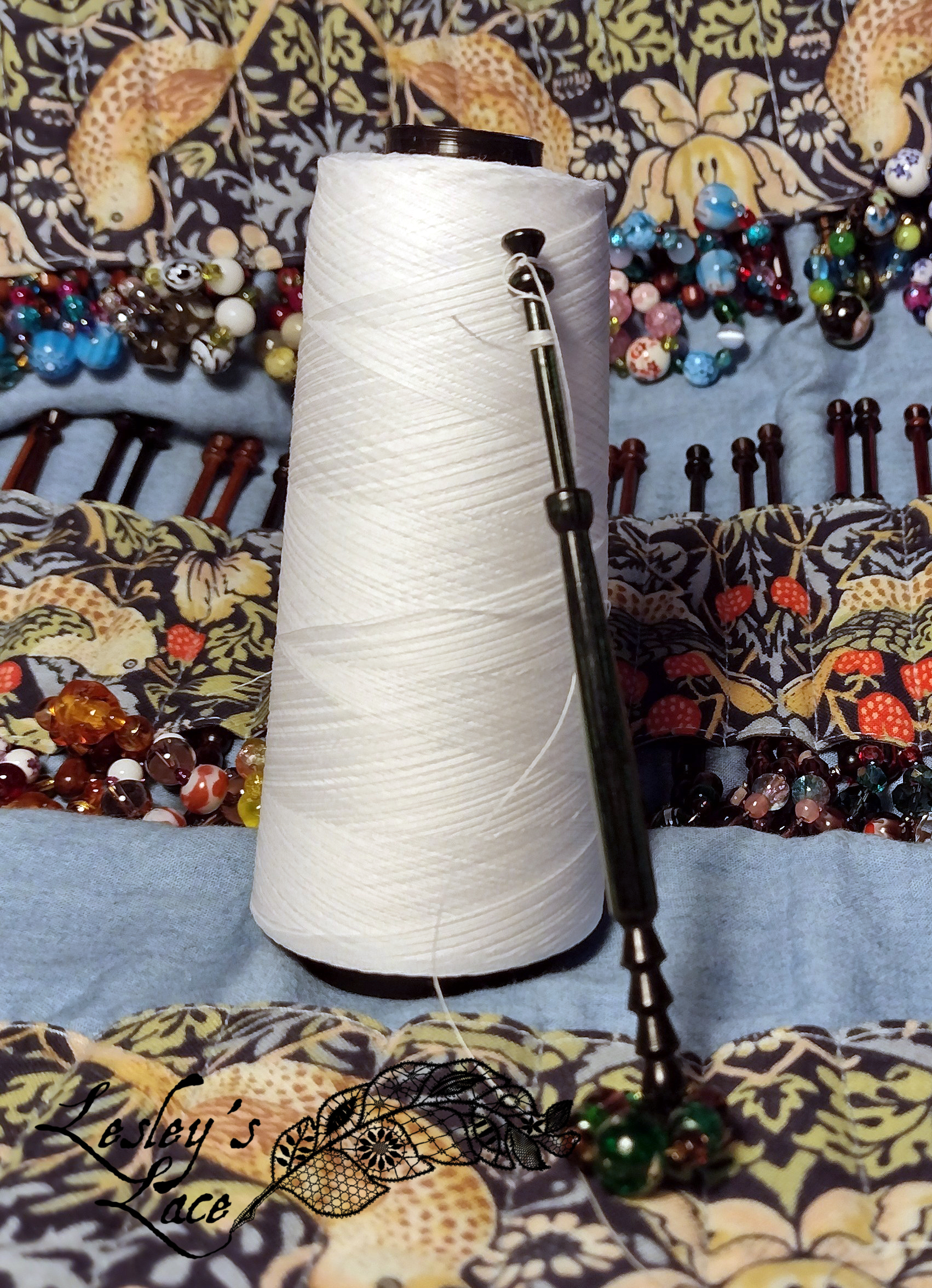
This is how I keep the thread clean. A hole in the top dispenses the thread and the reel stays still. The larger reels like this are designed to have the thread taken from the top of the reel, not from spinning around like the smaller ones.
 |
| Thread dispenser |


The downloadable .pdf pattern sheet is in the Files tab on my Lesley's Lace facebook page.
The A4 .jpeg can be copied from here, or my Lesley's Lace facebook page.
Please always respect the copyright of the designer.
This pattern must only be shared in its original form and cannot be sold.
If you wish to teach from this, or any other of my free patterns, please ask for permission first.
If you wish to include any of my patterns in group news letters or magazines, please ask first, and let me have a copy for my records.
Have fun!
I designed a charity ribbon pattern after being asked to sell a large donation of lacemaking equipment for Blood Cancer UK charity. The colour for this charity is red, but could be made in any colour for any charity fundraiser.
This pattern is my gift to any lace makers who would like to make a simple piece and to maybe help a good cause at the same time.

This pillow was passed to me having been rescued from being thrown away. It was unusable due to smell and rust but I like an occasional challenge so set to work.
The book which came with it was dated 1934.
"I feel sure this charming book on Lace-making will be a great help and incentive to out Guides....We owe Miss Milroy a deep debt of gratitude for the labour and time she has expended on bringing out such a valuable addition to our Guide literature.....Lace-making is one of the oldest and most beautiful of all our handicrafts."
I suspect the wood was taken from bits of cut down furniture as evidence by the green railway paint still on some pieces. The stuffing was cut up blanket and knitted wool, with a flock layer on top. The photographs show the work progress from original to finished dressed pillow along with the original hand drawn patterns.
I had to rebuild the pillow using high density EPS foam because I couldn't work with original materials.

I love the idea that some little girl guide's father or grandfather would have made this in their shed, a snapshot of the period.


Starting a two (workers) pair edge, how I do it. More experienced lace makers and books will show many different ways. With no one to teach me, this is what I figured out.
This is the edge I prefer because it gives a nice smooth outline on any work. It can easily be replaced with a standard pin and twist edge using one pair of workers, or even with a picot edge. I think the choice of edge is a lace makers decision on each piece.
On a two pair edge, the worker pair changes place with the left behind other worker pair each time they reach the outer edge.
Place pin in an outside hole. Hang four pairs open (open = like a rainbow).
Using the two pairs on right, (or two pairs on left) twist both pairs twice, cloth stitch, twist both pairs twice. Snuggle up to the top of the pin. Do not close around the pin. This is how I start a two worker pair edge. The four workers are now ready to work in opposite directions, two to the right, two to the left.
The passives pairs are hung open on a temp pin placed below the worker pin. For 3 pairs of passives you need 6 pairs of bobbins, one of each pair goes in the opposite direction. It is best to secure the passives on the opposite side as they will try and pull through until there are a few weavings to hold them in tension. Twist the 'spare' side threads around a pearl head pin and push into the pillow to secure the pairs out of the way.
Working to the left. Take the inner of the two pairs of worker, work through the 3 pairs of LH passives. Twist worker pair twice and place the pin, Work back through the passives, twist the worker pair twice, cloth stitch through the outer waiting worker pair and twist both worker pairs twice each. The two worker pairs have now changed position and the new inner worker pair is ready to work through the passives and so on.
The worker pair left on the outside is often given an extra twist.
Reference : Pattern 5 Jean Leader's Introduction to Bedfordshire, published by the Lace Guild UK.
Sunrise Heart start point.


What prompted me to have a lace maker as a central character I have no idea. Maybe it was my Mother, talking about researching her family tree. Some of her ancestors came over to this country via the route many lace makers had used to flee the religious persecution of that time.
I wanted to hear what the bobbins sounded like so I could be accurate in my descriptions of this disappearing skill. A chance sighting of a poster advertising a demonstration of lacemaking in the next village set me on a path I never saw coming.
The novels sat patiently in my computer while I fell down the lace making rabbit hole. So much to learn. Not just the making of the lace itself, but learning how to turn the bobbins, all the history, pattern making, lace schools, agents, trends and threads.
Now, several years later, I have returned to have another look at the novels and have decided to put each chapter online as I edit the first book. This is where you can follow the progress along with me, chapter by chapter.
Lesley

Part of my lace journey involved the making of the tools. I bought a little Proxxon db250 micro lathe, three basic wood turning chisels and faced the whirling dervish that was to become a bobbin. Very scary stuff!
Practicing on oak dowel, l made some basic and useable bobbins, l could have stopped there, turned a few dozen and been happy, but l discovered the exotic woods and there l was, falling down another rabbit hole.
The history and local variations of bobbins took me down another path of reseach, all those amazing stories in tiny sticks of wood and bone, if only they could speak. Saddest thing is knowing that most of them have been thrown on fires over the years when lace and lacemaking went out of fashion.
My choice of Midlands spangled bobbins meant l had to make a 1mm hole at the tail of each one. Discovered an amazing little gadget, an Archimedes drill which did the job just fine.
The local wood turning store was very kind and took me through all the products, l chose 300, 800 and 1200 grade sand paper, Sanding sealer and microcrystaline finishing polish.
The scary sharp tools, fast spinning wood and, worst of all, the vibration, limited me to one or two bobbins at a time. Even these could take me an hour. Watching Chris Parsons turning a bobbin on his youtube video was inspirational, but l knew l would never be able to be that proficient. I was pleased enough with myself for facing this fear and producing useable bobbins, but it was taking me away from my lace, and my lovely zen calm mind space. I would come in from the shed shaking sometimes, but at least l can say l did it!
 |
| An early skirt of my own bobbins. |
 |
| Purple heartwood on the lathe |
 |
| Ebony long handled tools |
I made several of these pin cushions to fit into the space of a half block on my block pillows. This saves space on the pillow for moving bobbins and, because the pins are always in the same place, I don't need to look up to reach for them.


Leafwing Butterfly
During the lockdowns of 2020/21, l was glad l had such an absorbing craft to keep me busy. I designed this butterfly pattern as an exercise in leaf (tally) making. Taking my simple line drawing one step further, l turned it into a pricking and published it as a free pattern for the Bobbin Lace Makers FB groups.


